
When most people think of autoimmune disorders, they usually imagine fatigue, joint pain, or the difficulties of managing ongoing symptoms. Less well recognized is how these conditions can also affect circulation and raise the risk for blood clots.
For women, who make up nearly 80% of those affected by autoimmune disorders, this connection is especially important. Beyond the day-to-day challenges of disease management, autoimmune conditions can contribute to serious complications such as pulmonary embolism, stroke, and pregnancy loss.
Antiphospholipid Syndrome
At the heart of this overlap is antiphospholipid syndrome (APS), a serious autoimmune condition. APS can develop independently or in conjunction with lupus. It is strongly associated with recurrent miscarriage, deep vein thrombosis, pulmonary embolism, and stroke, even in young, otherwise healthy women.
Equally important are other autoimmune conditions, such as lupus, rheumatoid arthritis, and thyroid disorders. Although less well known in this context, they also increase the risk for clotting through chronic inflammation and hormonal imbalance.
Understanding these intersections is crucial for successful blood clot prevention and treatment.

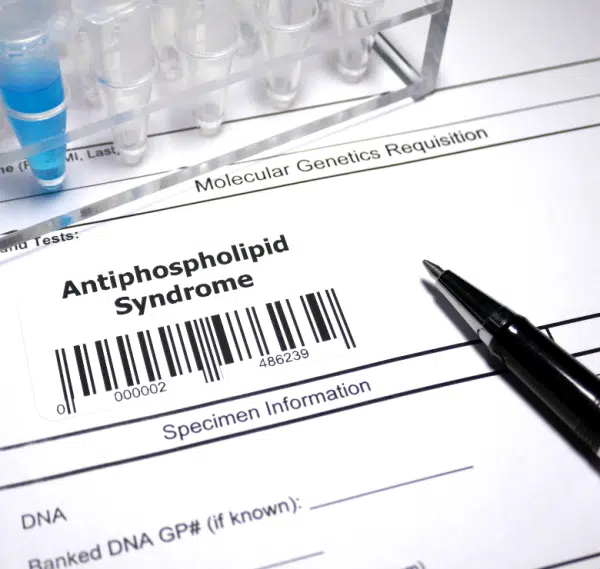
What Is Antiphospholipid Syndrome?
APS is an autoimmune disorder in which the immune system produces antibodies that mistakenly attack proteins bound to phospholipids in the blood. These antibodies, including lupus anticoagulant, anticardiolipin, and anti-β₂-glycoprotein 1, create a hypercoagulable state. Hypercoagulation increases the risk for blood clots in both veins and arteries.
Women Disproportionaly Affected
APS affects about 1 in 2,000 people in the United States, with about 70 percent of them being women. It can exist as a primary condition or as a secondary condition in people with lupus (systemic lupus erythematosus, or SLE). In fact, 30–40% of women with lupus test positive for antiphospholipid antibodies. This overlap significantly raises clot risk and can complicate family planning, pregnancy, and daily health management.
“I’ve had a long battle with seronegative APS, and I never received a full clotting panel until I started pushing for answers,” says Tina Pohlman, who was eventually diagnosed in 2002, when she was 29 years old, and who went on to become the co-founder of the Antiphospholipid Syndrome (APS) Foundation of America.
Seronegative APS is when someone has the health problems linked to antiphospholipid syndrome, like blood clots or pregnancy loss, but the usual blood tests don’t show the antibodies physicians usually look for. It may still be diagnosed as APS, even though the lab tests do not confirm it, because the clinical signs strongly match.
Autoimmune Disorders and Clotting: A Wider Lens
Beyond antiphospholipid syndrome, conditions such as lupus, rheumatoid arthritis, and thyroid disorders each contribute to shaping the risk for clotting through chronic inflammation, vascular changes, or hormonal imbalances.
Understanding these connections provides a more comprehensive understanding of how autoimmune disease and clotting disorders intersect in women’s health.
Women’s Health at the Crossroads
For women living with autoimmune conditions, health is rarely a single concern. This is because the same diseases that cause fatigue, pain, or immune problems can also increase the risk for dangerous blood clots. These risks don’t exist alone. Instead, they connect with the milestones and choices that shape women’s health throughout their lives.
“One of the most important things for women to understand is that APS is not just a clotting disorder—it affects every stage of women’s health,” says Pohlman. “From birth control to pregnancy and menopause, your choices are important, and being informed can literally save your life.”
Health Implications
This convergence means women must consider clotting risk when they are already making deeply personal and often complex health decisions. APS highlights this crossroads, but lupus, rheumatoid arthritis, and thyroid disorders also add to higher clotting risk during these stages. Too often, however, conversations about women’s health neglect to include clotting.

Also, for women who have already experienced clotting due to APS, other health issues, including mental health issues, might emerge.
“The impact of a dangerous blood clot doesn’t end when the clot resolves or when a diagnosis like APS is received. In fact, the mental health effects, like anxiety, fear of recurrence, even PTSD, can be overwhelming,” explains Sara Wyen, who experienced a life-threatening blood clot in her lung when she was just 28 years old, which led to her APS diagnosis. “Talking about those struggles openly is essential so no one feels alone in their healing, and addressing clotting risk in women’s health is essential for prevention, better outcomes, and true patient-centered care.”
Contraception Choices
For women with APS or lupus, estrogen-containing contraceptives (such as combined hormonal pills, patches, and rings) are unsafe because they significantly increase the risk of clotting events. (Current Rheumatology Reports)
“If you are a woman taking or considering birth control, it’s crucial to discuss your risk for blood clots,” Wyen emphasizes. “Unfortunately, many women are not routinely screened for clotting disorders before starting hormonal birth control, leaving them unaware of this danger.”
Pregnancy and APS
APS is one of the leading causes of recurrent pregnancy loss. Women with APS face higher risks of miscarriage, stillbirth, preeclampsia, and preterm birth. The stakes are highest when APS is undiagnosed.
Data show that about 22% of APS patients develop venous thrombosis and 7% experience stroke. Nearly one-quarter of clotting events occur during pregnancy or in the weeks following delivery.
 The postpartum period is one of the most vulnerable times for clotting risk in any woman, especially during the first 6–12 weeks after delivery (Heit et al., 2005, Annals of Internal Medicine). For women with APS or other autoimmune conditions, that risk is even greater.
The Role of Testing
“Testing is essential for women with unexplained blood clots or recurrent pregnancy loss, since a confirmed diagnosis of APS or other autoimmune disorder can change outcomes dramatically,” Pohlman says. “Research has shown that with early diagnosis and treatment, with a combination of low-dose aspirin and/or low molecular weight heparin injections, many women affected by APS can carry pregnancies to term.”
Pohlman also notes that hydroxychloroquine is also showing strong benefit in pregnant women affected by APS.
Coordinated care with a high-risk OB/GYN and, ideally, a hematologist provides the best path forward for safe pregnancies in women affected by autoimmune disorders that increase clotting risks.
Menopause and HRT
Menopause is another stage of life when the risk of clotting needs careful evaluation. While hormone replacement therapy (HRT) can help with hot flashes, bone health, and other symptoms, estrogen-based HRT is generally unsafe for women with APS or clotting disorders. This can lead to difficult choices in managing symptoms, making personalized care and honest conversations with healthcare providers especially vital.
Non-estrogen therapies and lifestyle strategies may help some women find relief, but the key is customizing treatment to avoid increasing clot risk. APS is not a short-term condition and influences decisions throughout women’s health, including menopause.

Sara Wyen, BCRN Founder
“Connecting with others in the clotting community has been life-changing for me. Knowing there are people who truly ‘get it’ makes the journey less isolating and more hopeful.” Sara Wyen, Blood Clot Recovery Network Founder.
Lifelong Advocacy and Education
APS and other autoimmune-related clotting risks remain under-recognized, and many women spend years searching for answers. That’s why persistence, documentation, and patient advocacy are so essential. Women should not hesitate to seek second opinions, ask for comprehensive clotting panels, and bring clotting risk into every reproductive health discussion.
“Education is the first step toward prevention, and advocacy is how we make sure those lessons reach every woman who needs them,” Wyen says. “The more we talk about blood clots openly, honestly, and often, the better chance we have to save lives.”
What Women Need to Know
Living with an autoimmune condition can bring many questions, especially when it comes to clotting risk. The good news is that there are clear steps you can take to protect your health and make informed choices about birth control, pregnancy, and long-term care. Here’s what every woman should know when APS or clotting risk is part of the picture.
Voices Amplified
For many women, autoimmune disease and clotting are inseparable concerns. APS serves as a powerful entry point into this issue, but the broader autoimmune landscape reveals just how much healthcare must evolve to reflect women’s real experiences.
By amplifying voices like Tina’s and Sara’s, women who have experienced, advocated for, and educated others about APS, we move closer to a future where care is informed, compassionate, and evidence-based.
The Rowan Foundation is dedicated to amplifying these voices and promoting education, research, and patient-focused care. When women access knowledge and resources, they gain the ability to protect their health and create better outcomes for themselves and future generations.
Awareness increases knowledge. Knowledge drives advocacy. Advocacy saves lives.
- For more information about APS, visit the Antiphospholipid Syndrome (APS) Foundation of America.
- For more information about recovery after a blood clot or managing a clotting disorder diagnosis, visit the Blood Clot Recovery Network.
- Learn more about the work of the Rowan Foundation.

Tina Pohlman, APSFA Co-Founder


